
Feature

Last TTO Discussion Forum for 2021 Discusses Philippines-China Bilateral Relatio…


Last December, Asia Pacific Pathways to Progress held the last Track Two Observer Discussion for 2021, with the topic “Philippines-China Relations During the Duterte Administration.” The forum served as a...

Read more

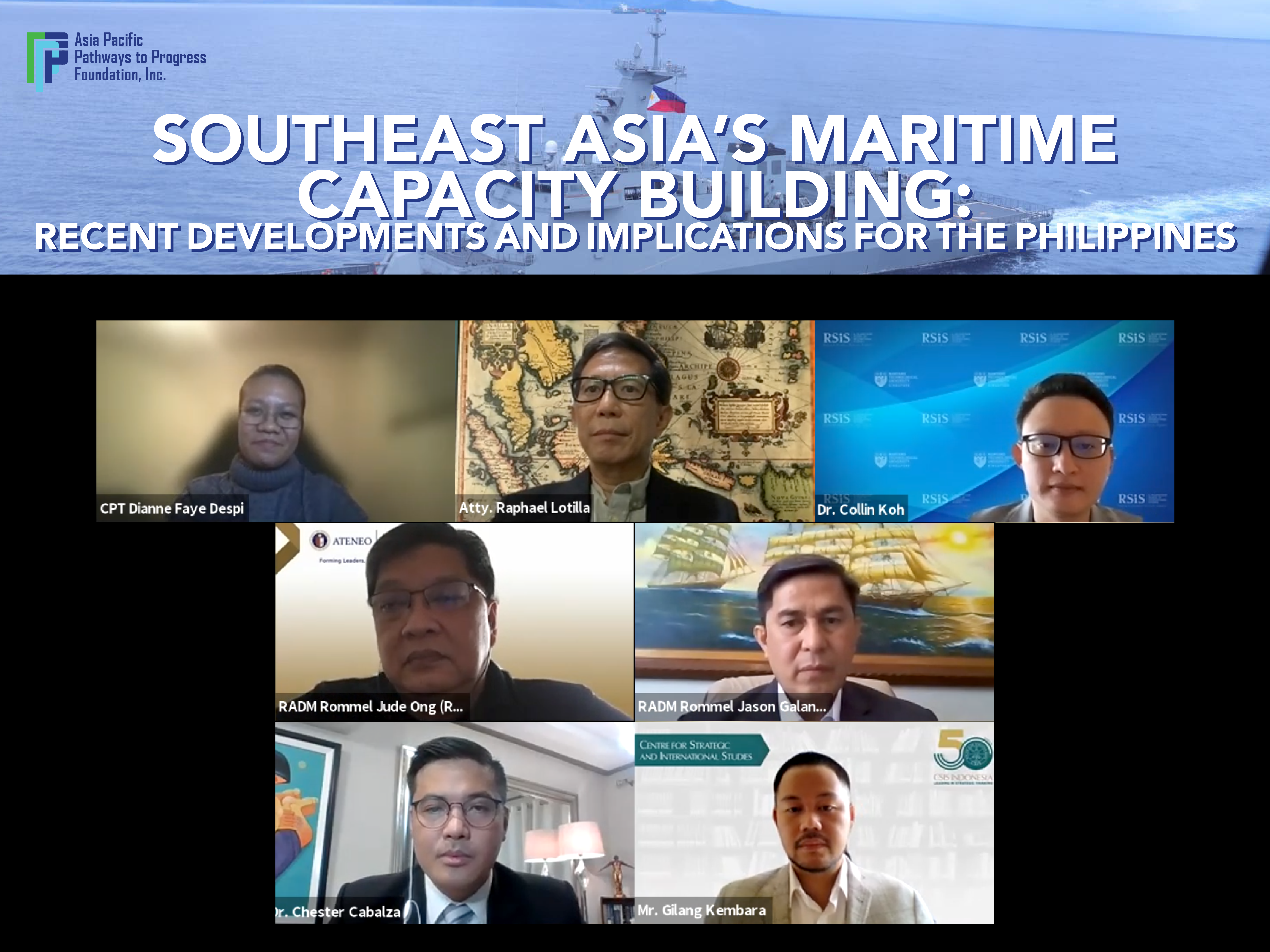
APPFI Organizes Webinar Discussing Maritime Capacity Building in Southeast Asia

Noting the continuation of maritime security issues in Southeast Asian waters and the intensification of tensions among powers, Asia Pacific Pathways to Progress Foundation organized the webinar, “Southeast Asia’s Maritime...

Read more

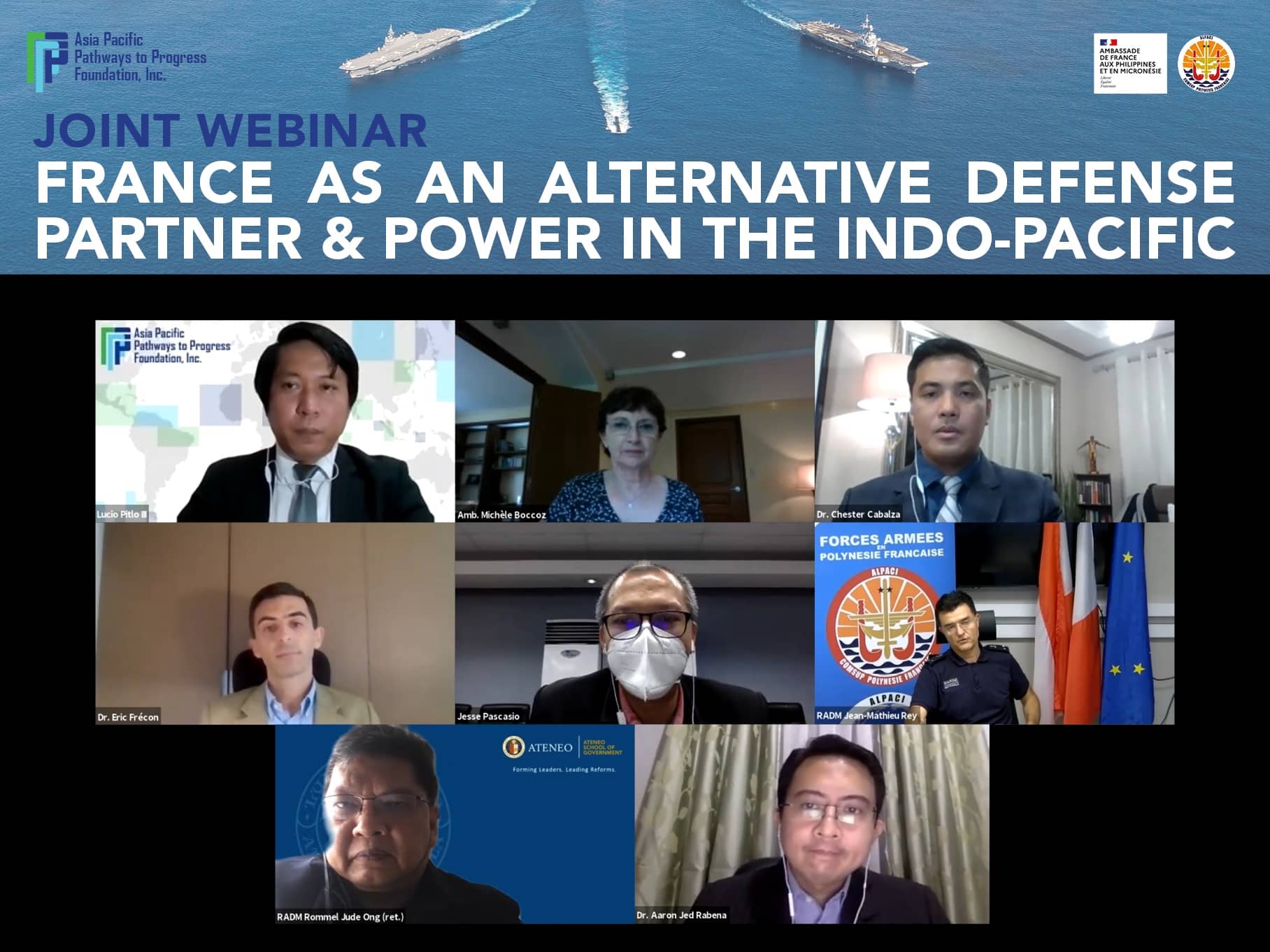
Webinar Discusses France as an Indo-Pacific Power

In recent years, a myriad of issues has emerged to destabilize the Indo-Pacific region, with challenges brought about by climate change, resource overextraction, and growing great power competition being among...

Read more

TTO Discussion Forum Kicks Off With Webinar on ASEAN and the Myanmar Coup

Asia Pacific Pathways to Progress Foundation kicked off the Track Two Observer Discussion Forum Series last May 21 with a webinar with the theme, “ASEAN and the Myanmar Coup,” focusing...

Read more

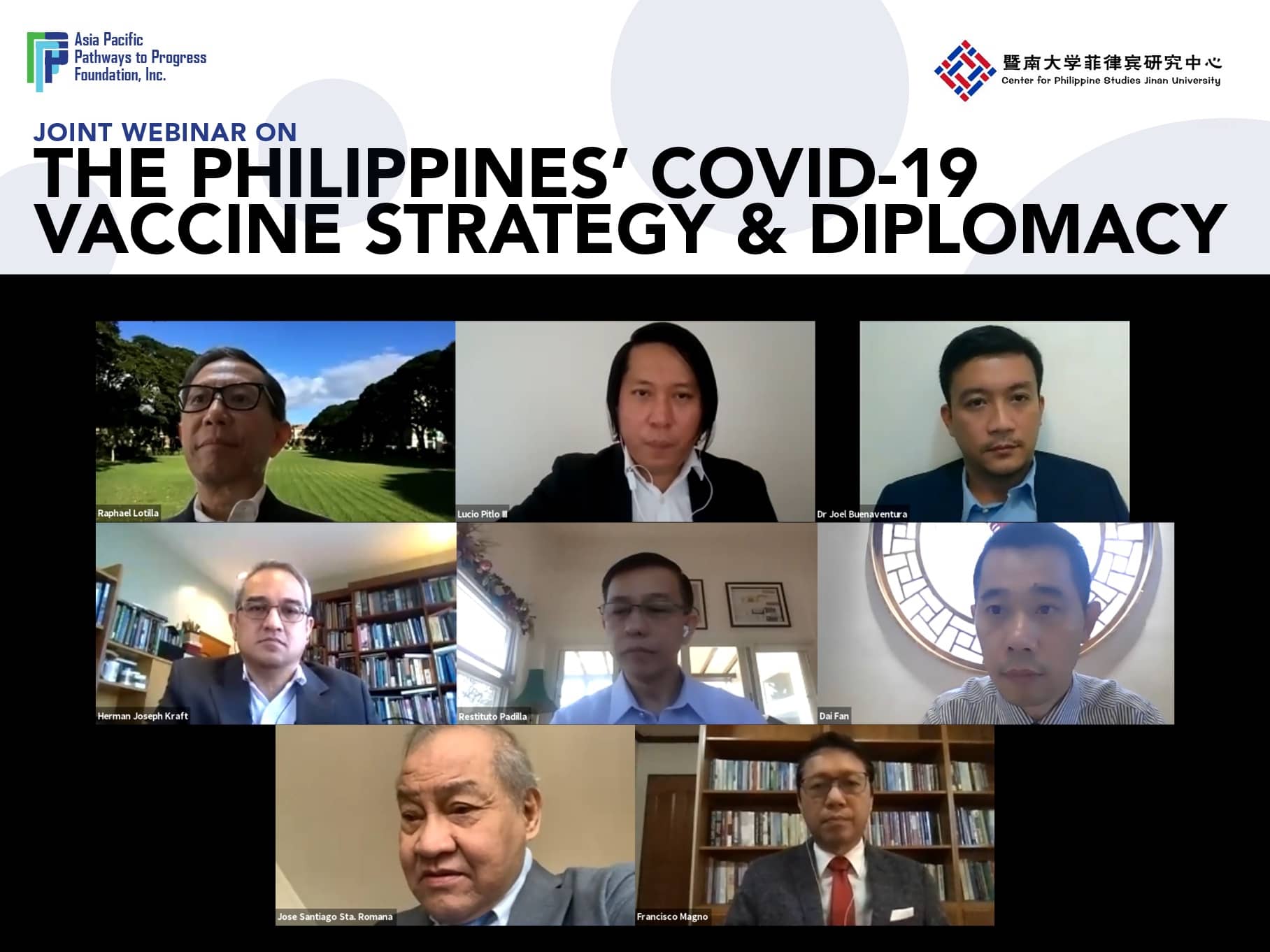
Pathways Organizes Webinar on PH Vaccine Strategy

Last February 25, Asia Pacific Pathways to Progress Foundation, in partnership with the Center for Philippine Studies of Jinan University, organized a Joint Webinar on The Philippines’ COVID-19 Vaccine Strategy...

Read more
201602.Commentary.ShahaniLeticia
Photo credit: Lila Shahani | From: isiswomen.org

Philippine-Chinese relations, between these two neighbors who have peacefully interacted with each other in the past, are both profound and complex because they have been based on people-to-people relations.  The Philippines, representing the smaller and younger culture, has been on the receiving end of Chinese culture and migration for centuries. With its ancient empires continuing into the People's Republic of China (PROC), and its organized systems of writing and learning, China has had a great impact on Philippine culture in a way not comparable to the impact of Philippine culture on Chinese culture (of which little is known). Think of how Chinese food has become the staple of ordinary Filipino cooking- lugaw, pancit, siopao. Or consider the countless intermarriages between the two peoples so that those who make the list of the richest Filipinos are majority Filipino-Chinese. Moreover, most Filipinos have a sprinkling of Chinese blood in them. Common Filipino words pertaining to family relationships, business, etc. are of Chinese origin- kuya, ate, tawad.   Such Chinese influence is not unique to the Philippines; it is widespread throughout the ASEAN region.

Philippine foreign policy did not develop into the eyeball-to-eyeball relationship it now is between the Philippines and China until the outbreak of the West Philippine Sea (WPS) issue, well into the 1990s. It is true that relations with China under Chiang-Kai-Shek were severed when Mao-Tse-Tung won control over China, but China still seemed far removed from us, and ASEAN served as a buffer to a possible "domino" effect of communism.  The quarrel then was about ideology, but even with an active leftist movement in the Philippines, the fundamentals of our foreign policy - sovereignty, national territory, and the national interest - remained unaffected by the ideological rift with China.

With the issue on the West Philippine Sea, however, the fundamentals of Philippine-Chinese relations have become drastically altered, and now need to be understood within the context of a threatening military-economic power game. As one who was born and raised in Lingayen, Pangasinan's capital town, right smack on the Lingayen Gulf, where thousands of families depend on the sea for their livelihood,  issues of sovereignty and territorial integrity are to me not intellectual issues to be analyzed for academic or theoretical  lessons in international relations, but they are real life-and-death issues, as for millions of Filipinos and hundreds of  local government units. "Foreign policy" has thus become conflated with "domestic policy".

What must Filipinos do? The list is long but here are my list of priorities. We have to understand and act accordingly that: (a) as citizens of the Philippines, we are duty-bound to defend our sovereignty, national territory and national interest because no one else will;  (b) under the UN Convention on the Law of the Sea, ratified by the Philippines and China, the Philippines, as an archipelago, and China, as a coastal state, both have rights and obligations that must be respected and honored; (c) as citizens of the Philippines we have a responsibility to defend a coastline which happens to be the 5th longest in the world; (d) we have to live peacefully with the world, especially with our neighbors. However, Filipinos MUST know the realities of their nationhood FIRST and therefore must actively FORGE, TOGETHER WITH THE STATE, AN INDEPENDENT FOREIGN POLICY.

Filipinos want to live in peace with their Chinese neighbors, and people-to-people relationships are extremely important. But Filipinos must understand that no one will defend the Philippines except the Filipinos.  Our colonial past should teach us this painful lesson- we have been conquered by Spain, the USA, Japan and we have been bullied by China. Of course, let's give diplomacy, both at governmental as well as people-to-people levels, a chance. But let us take the path towards an independent foreign policy; the journey is long and uncertain but for Filipinos there is no other way.

                               E N D
Events

Last TTO Discussion Forum for 2021 Discusses Philippines-China Bilateral Relatio…

Last December, Asia Pacific Pathways to Progress held the last Track Two Observer Discussion for 2021, with the topic “Philippines-China Relations During the Duterte Administration.” The forum served as a...

Read more

APPFI Organizes Webinar Discussing Maritime Capacity Building in Southeast Asia

Noting the continuation of maritime security issues in Southeast Asian waters and the intensification of tensions among powers, Asia Pacific Pathways to Progress Foundation organized the webinar, “Southeast Asia’s Maritime...

Read more

Second TTO discusses Europe and Southeast Asian Maritime Security

Asia Pacific Pathways to Progress Foundation held the second Track Two Observer Discussion Forum last October 7, 2021, with the topic Europe in Southeast Asia: Maritime Security Aspects. The forum’s...

Read more

Webinar Discusses France as an Indo-Pacific Power

In recent years, a myriad of issues has emerged to destabilize the Indo-Pacific region, with challenges brought about by climate change, resource overextraction, and growing great power competition being among...

Read more

TTO Discussion Forum Kicks Off With Webinar on ASEAN and the Myanmar Coup

Asia Pacific Pathways to Progress Foundation kicked off the Track Two Observer Discussion Forum Series last May 21 with a webinar with the theme, “ASEAN and the Myanmar Coup,” focusing...

Read more

Pathways Organizes Webinar on PH Vaccine Strategy

Last February 25, Asia Pacific Pathways to Progress Foundation, in partnership with the Center for Philippine Studies of Jinan University, organized a Joint Webinar on The Philippines’ COVID-19 Vaccine Strategy...

Read more

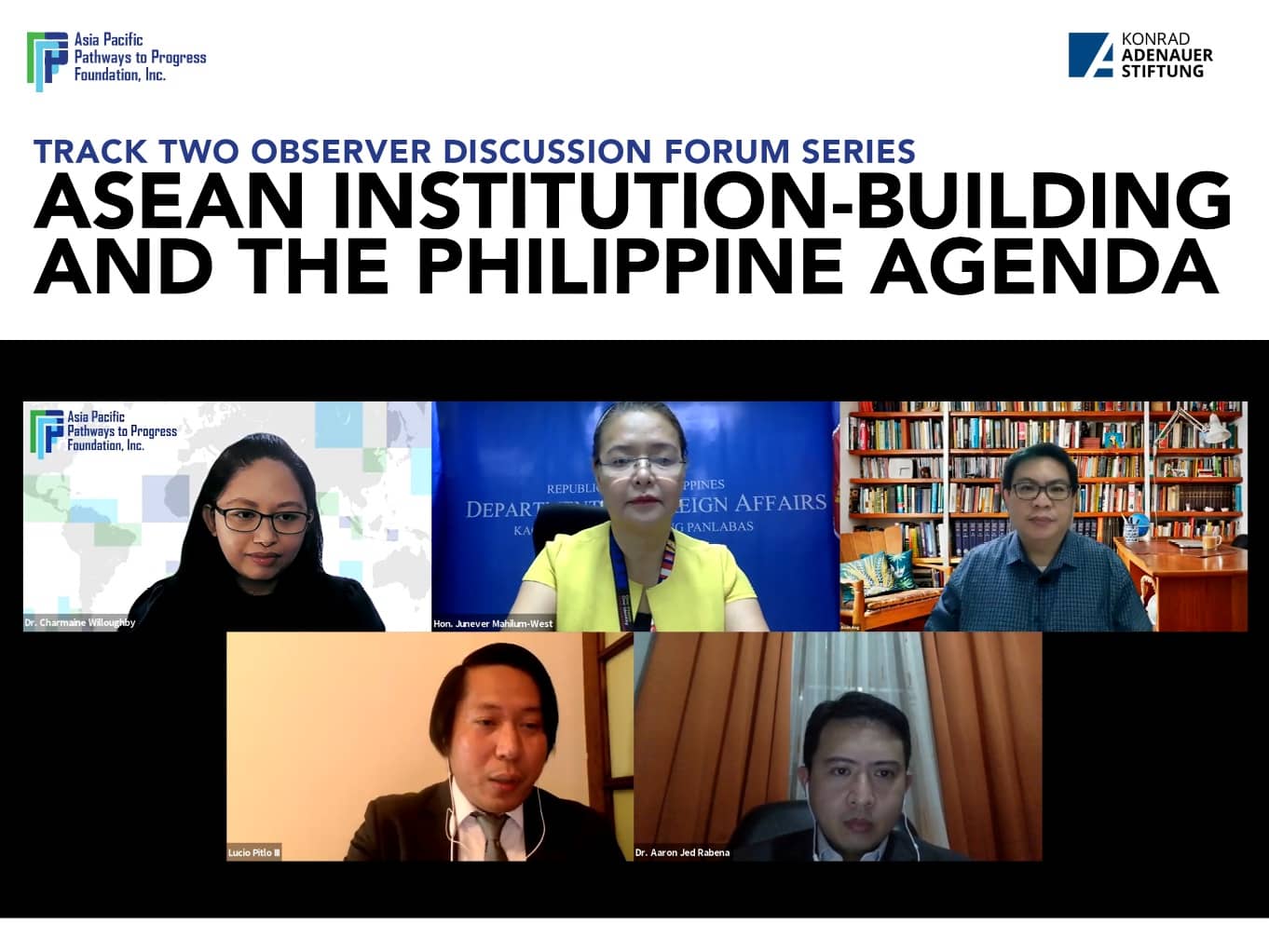
Track Two Observer: ASEAN Institution-Building and the Philippine Agenda

Asia Pacific Pathways to Progress Foundation Inc. and Konrad Adenauer Stiftung hosted a Track Two Observer webinar looking at the prospects of Southeast Asia’s economic recovery while reeling from the...

Read more

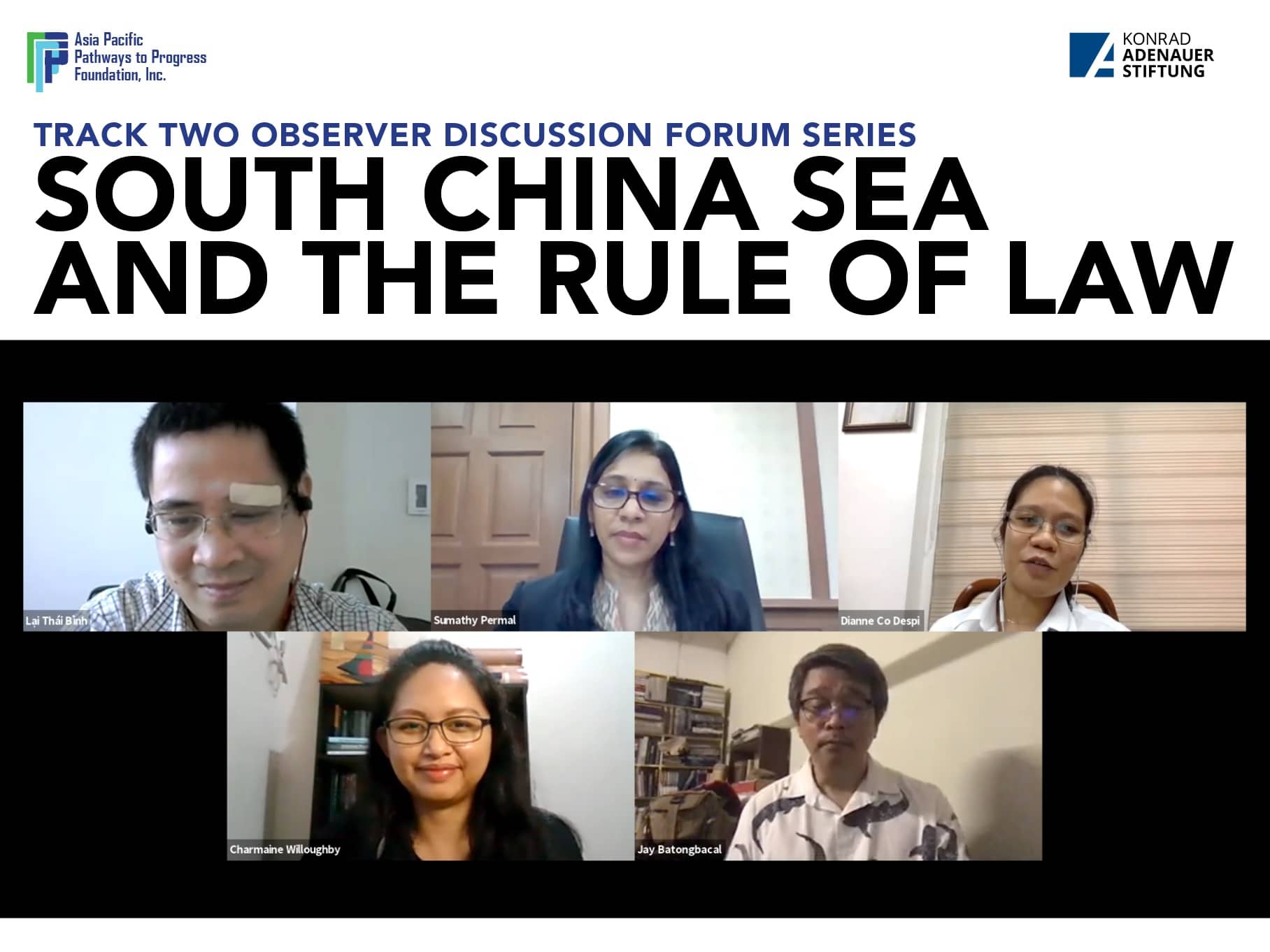
Track Two Observer: South China Sea and the Rules-Based Order

The Asia Pacific Pathways to Progress, with the support of the Philippine Office of Konrad Adenauer Stiftung, organized a Track Two Observer Discussion Forum to look back at the recent...

Read more

Track Two Observer: International Defense and Security Engagements

Experts and stakeholders came together in a Track Two Observer webinar to confer on the latest developments on Philippines international defense and security engagements. Highlighted during the discussion are the...

Read more

Publications

Strategic Insight 2019 Volume 2

Strategic Insight is a collection of original commentaries by APPFI’s in-house analysts covering 2019 developments in Philippine foreign relations. The individual essays have been published and may also be accessed on the Commentaries...

Read more

Strategic Insight 2019 Volume 1

Strategic Insight is a collection of original commentaries by APPFI’s in-house analysts covering 2019 developments in Philippine foreign relations. The individual essays have been published and may also be accessed on the Commentaries...

Read more

Strategic Insight 2018

Strategic Insight is a collection of original commentaries by APPFI’s in-house analysts covering 2018 developments in Philippine foreign relations. The individual essays have been published and may also be accessed on the...

Read more

RTD Report: ASEAN-China Cooperation in the Brunei-Indonesia-Malaysia-Philippines…

Background 25 years since its establishment, the geographic area covering the Brunei-Indonesia-Malaysia-Philippines East ASEAN Growth Area (BIMP-EAGA) now appears to be a nexus of the subnational, national, and regional economic and...

Read more